

Responding to the consultation regarding the proposed European restriction
Since 2023, the European Commission has been studying the possibility of a broad restriction on PFAS.
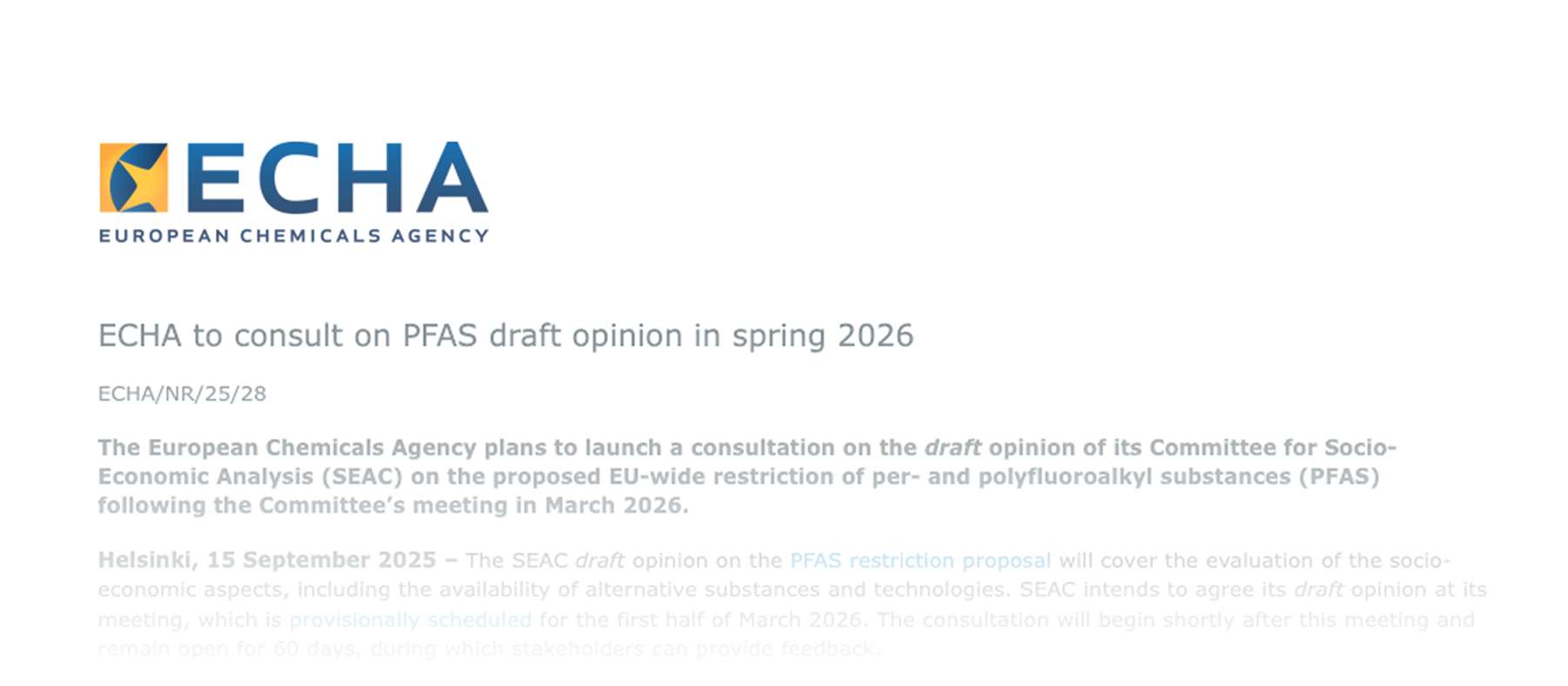
Starting in March 2026, it will launch a major consultation open to all stakeholders — businesses, associations, researchers, the general public — on the socio-economic impact of the proposed restrictions. The findings will be considered for developing the future restriction project.
This is therefore a crucial opportunity for economic actors in favour of phasing out PFAS to make their voices heard.
What is this all about?
European restriction project
Restricting the production and consumption of all PFAS in Europe. This is the aim of the 2023 draft regulation that the European Commission is expected to adopt—or not—by the end of 2026. To find out more about this European-wide restriction project, read our article on the subject.
The ambition and scope of this project are currently under debate. The project could either confirm its initial ambition—that is, to phase-out all PFAS with a few exceptions for essential uses—or be watered down with exclusions for a multitude of uses, or perhaps be limited to only a few PFAS.
The upcoming consultation
Like all European regulatory texts, the draft is going through consultation phases.
In 2023, an initial consultation was organised. More than 5,600 comments were submitted, many from the chemical industry, which defended itself by arguing, for example, that plastics containing PFAS were harmless. This intense lobbying was exposed by the revelations of the international collaborative investigation The Forever Pollution Project.
In March 2026, a consultation will be organised to present a new version of the draft and gather opinions on the potential socio-economic impacts of limiting PFAS in different sectors.
The consultation will last two months (60 calendar days) and will take the form of an online questionnaire.
Why is this important?
Three years ago the consultation enabled manufacturers, especially large chemical companies, to influence the direction taken by the restriction proposal. There is no doubt that this new consultation will give these stakeholders the opportunity to further limit future restrictions.
Participating in this consultation is therefore critical for economic stakeholders campaigning for the PFAS phase-out.
What can I do as a business?
First of all, since every voice matters, you can take the time to respond to the consultation. With the assistance we provide, we estimate that this will take around two hours.
Secondly, you can encourage your partners, suppliers and customers to do the same, with a view to transitioning your value chain.
Last but not least, you can also openly advocate for the phase-out of PFAS. To this end, we will publish a manifesto during the consultation phase and invite all organisations that wish to do so to join us.
How bye bye PFAS can help you
Our role in this consultation will be threefold:
- Provide a toolbox to help you respond to the consultation. At first glance, the consultation questionnaire may seem complex to complete. To make the process easier for you, we will publish resources such as educational articles, frequently asked questions, bibliographies by topic, email templates to send to your suppliers, etc.
- Provide free, on-demand support to help you find answers to any questions you may have. For this, we will call on the experts (scientific, legal, etc.) involved in bye bye PFAS.
- Raise awareness of this consultation and give visibility to the economic actors who have taken the time to respond to it, in order to create a snowball effect and encourage the participation of as many economic stakeholders as possible.